How Visible Retail Guards Reduce Employee Theft in Downtown Toronto
Operating a high-volume retail storefront or flagship boutique in Downtown Toronto—whether situated inside the massive Eaton Centre, along the dense pedestrian corridors of Queen Street West, or nestled in the luxury pockets of Bloor-Yorkville—presents retail operators with relentless asset protection challenges. While organized retail crime and brazen shoplifting dominate the daily news cycle, seasoned retail operations managers understand that external threats only account for a fraction of total inventory loss. The most insidious, expensive, and difficult-to-detect threat to your profit margins often comes from within: internal employee theft.
According to data compiled by the Retail Council of Canada, employee dishonesty accounts for nearly a third of all retail shrinkage nationwide. While an opportunistic shoplifter might steal an item worth $175, an internal employee actively engaged in theft steals an average of $2,500 in cash or merchandise before they are ever caught. Employees know where the camera blind spots are, they understand how to manipulate point-of-sale (POS) systems, and they have unrestricted access to premium backroom inventory. Relying entirely on passive surveillance cameras, internal management audits, or basic "honor system" policies leaves your business completely exposed to systemic internal bleeding. For downtown retail owners, mitigating internal shrinkage requires the deployment of a professional, unbiased, third-party security guard. A visible uniformed presence completely disrupts the psychological opportunity required for employee theft, ensuring your inventory remains secure and your operational margins remain intact.
The Devastating Financial Reality of Internal Shrinkage
Internal theft is rarely a one-time event; it is a systematic, prolonged drain on a store's profitability. Because employees have legitimate reasons to handle cash, process returns, and move inventory through unmonitored back hallways, their thefts are exceptionally difficult to detect without dedicated, unbiased oversight.
Consensus Analysis: In-House Management Audits vs. Third-Party Guard Deployments
When attempting to curb internal shrinkage, corporate retail directors frequently debate whether to rely on store managers to police their own staff or to outsource employee auditing to a professional third-party security firm.
The Verdict:
- Avoid This: Relying exclusively on store managers or internal shift supervisors to execute staff bag checks and monitor employee break areas. In a busy downtown retail environment, managers are overwhelmed with customer service escalations, scheduling, and sales targets; they simply do not have the time to audit staff rigorously. Furthermore, internal managers often develop close personal friendships with floor staff, creating a massive conflict of interest that allows "sweethearting" (giving unauthorized discounts to friends) and direct theft to go completely unreported.
- Buy This: Station a professional, third-party uniformed security guard at your primary staff entrances, backroom corridors, and loading docks. An external security guard operates completely independently from your retail staff hierarchy. They do not have personal relationships with your cashiers or stock associates, ensuring that all security protocols, bag checks, and access controls are enforced strictly, objectively, and without bias.
Calculating the True Overhead of Unchecked Employee Theft
The economic damage caused by internal theft cascades rapidly through your downtown operation. Beyond the direct wholesale cost of stolen merchandise, systemic employee theft severely corrupts your inventory data. When an employee steals an entire case of premium cosmetics from the backroom, the inventory management software still registers those items as "in stock." As a result, the automated system fails to trigger a reorder, leading to empty shelves and lost legitimate sales when paying customers arrive to purchase the product.
Furthermore, internal theft operations—especially organized "sweethearting" rings involving multiple cashiers—are deeply corrosive to company culture. Honest employees who witness internal theft but see no active security presence often become demoralized or assume that management simply does not care, leading to high turnover among your best staff members.
| Shrinkage Factor | Unsecured Internal Retail Environment | Fortified Third-Party Guard Layout |
| Direct Employee Asset/Cash Loss | $2,500+ per compromised employee | $0.00 (Theft Deterred) |
| Lost Sales Due to Phantom Inventory | $1,500 - $4,000 (CAD) | $0.00 (Accurate Stock Levels) |
| Managerial Investigation Downtime | $1,200 (CAD in lost productivity) | $0.00 (Outsourced to Security) |
| Honest Employee Turnover Costs | $3,500+ per replacement hire | $0.00 (Stable, Accountable Culture) |
| Total Estimated Financial Impact | $8,700 - $11,200+ (CAD) | $0.00 |
By deploying a professional, third-party security presence, retail owners immediately signal that the business is actively monitored. This proactive investment is mathematically superior to absorbing the devastating, compounding losses generated by an unchecked internal theft ring. For retail operators looking to understand how these procurement principles scale across different commercial environments, reviewing our foundational manual on 2026 construction site security guidelines for GTA contractors provides excellent context on establishing baseline risk management workflows.
Engineering an Anti-Internal Theft Security Blueprint
Eliminating internal shrinkage in a fast-paced downtown retail environment requires a strategic, procedural security layout that closes operational loopholes without creating a hostile workplace for your honest employees.
1. Independent Shift-Change Audits and Bag Checks
The most vulnerable period for internal theft occurs during shift changes and store closing procedures. Employees carrying large personal backpacks or oversized coats can easily conceal high-value inventory before walking out the staff exit.
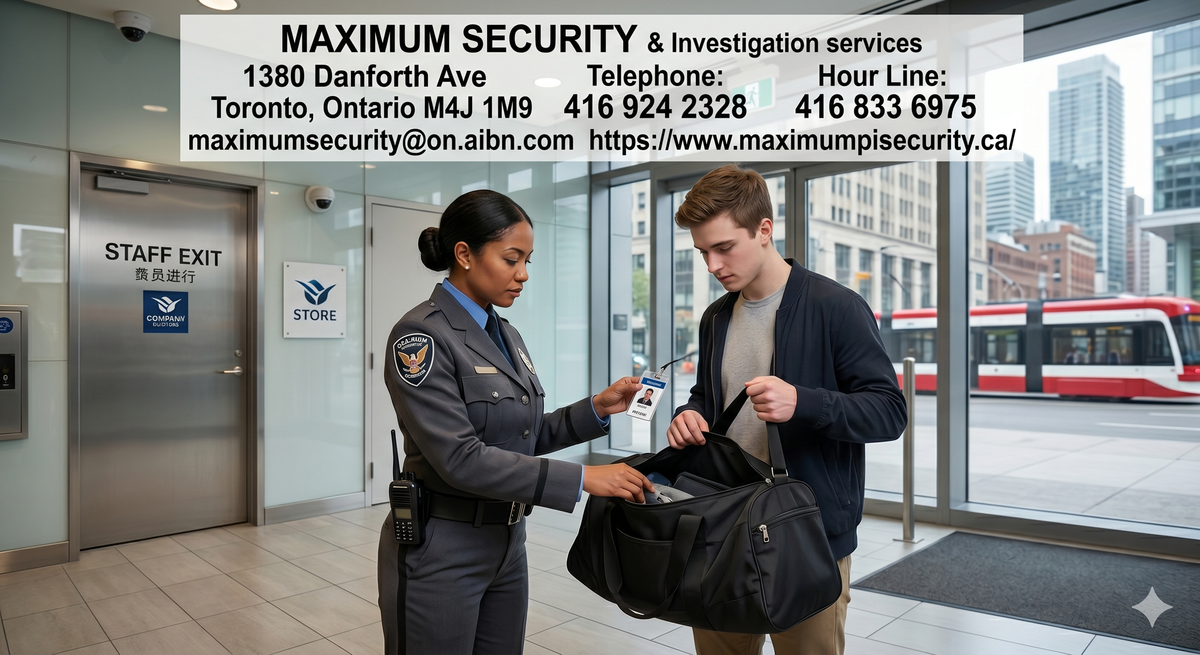
To neutralize this vulnerability, retail operations must implement mandatory, third-party shift audits. Your contracted security guard should be stationed directly at the designated employee exit. As staff members clock out, the guard executes a professional, respectful visual inspection of all personal bags, backpacks, and oversized coats. Because the guard is a third-party contractor, they enforce this policy universally, eliminating accusations of managerial favoritism or bias. This daily, visible checkpoint instantly removes the physical opportunity required to smuggle inventory out of the building.
2. Securing the Backroom and Loading Dock
While the sales floor is heavily monitored by cameras and management, back stockrooms and rear shipping docks are frequently left unattended. Employees routinely exploit these "blind zones" to skim inventory directly off incoming delivery pallets before the items are ever entered into the store's POS system.
To secure these critical logistical zones, restrict backroom access exclusively to authorized personnel using electronic keycards, and task your uniformed guard with monitoring all inbound and outbound vendor traffic. The guard must cross-reference all incoming delivery manifests against the actual physical boxes being unloaded, ensuring that delivery drivers and receiving staff are not colluding to short-ship the store and split the stolen merchandise later. For operations seeking specialized guarding models to protect premium retail environments, incorporating the protocols in our guide on uniformed retail security guards and shoplifting deterrence strategies for 2026 provides excellent context for structuring holistic store protection.
3. The Psychological Deterrent of an Unbiased Uniform
The "Fraud Triangle" dictates that internal theft occurs when three elements align: Motivation, Rationalization, and Opportunity. While a business owner cannot control an employee's personal financial motivation or their internal rationalization, they possess complete control over the "Opportunity" factor.
A sharp, professional security guard actively patrolling the store and executing randomized locker room sweeps shatters the perception of easy opportunity. When an employee knows that an unbiased, highly trained professional is actively watching the back hallways and monitoring point-of-sale voids, the perceived risk of being caught heavily outweighs the potential reward of the theft.
Sourcing Verified B2B Security in Downtown Toronto
Acquiring professional security guard coverage for a downtown retail storefront requires a realistic understanding of corporate agency pricing structures across Southern Ontario. Retail owners cannot evaluate security proposals based on minimum-wage expectations. In the 2026 Ontario market, a legitimate, compliant security agency must operate under the strict guidelines of the Private Security and Investigative Services Act (PSISA), pricing contracts to cover massive corporate infrastructure, including multi-million-dollar commercial general liability insurance, WSIB clearings, and rigorous pre-employment background screening for all deployed guards.
For active commercial retail storefronts across Downtown Toronto, corporate procurement teams should budget for the following agency bill rates:
- Static Uniformed Retail Guard (Tier 1): Billed at $38.00 to $48.00 per hour (CAD). This involves a highly visible guard executing continuous floor patrols, managing staff bag checks at the exits, and monitoring inbound delivery manifests at the loading dock.
- Covert Loss Prevention Specialist (Tier 2): Billed at $45.00 to $58.00 per hour (CAD). This involves a plainclothes operative with advanced legal training deployed to conduct covert internal investigations, monitor POS systems for sweethearting, and build formal prosecution cases against organized employee theft rings.
- Randomized Mobile Vehicle Patrol (Tier 3): Billed at $45.00 to $75.00 per individual site check (CAD). This option provides unpredicted, thoroughly documented exterior sweeps for your rear laneways and staff parking areas after closing, presenting an outstanding balance of risk mitigation and cost containment.
Hiring an organization that quotes rates significantly below these commercial baselines—such as $22.00 to $25.00 per hour—is a direct indication that the provider is cutting critical compliance corners. If you hire a cut-rate, unverified security company, you run the risk of the "security guard" actually colluding with your staff to facilitate theft. To understand how to properly vet B2B vendors, reviewing our guide on loss prevention strategies for shopping centers in Markham is an essential step for any operations director.
If your downtown storefront, luxury boutique, or high-volume pharmacy requires an unyielding line of defense to eliminate internal shrinkage, establishing professional protection is straightforward. Retail operators can easily connect with verified B2B vendors to request a custom security quote from Maximum PI Security to deploy certified personnel, execute unbiased staff audits, and secure valuable commercial assets against internal threats.
Compliance, Liability, and the PSISA
Delegating employee auditing and bag checks to a licensed, third-party security agency provides massive liability protection for your retail corporation. If an internal store manager accuses an employee of theft, searches their belongings improperly, or detains them without absolute proof, the employee can immediately file a devastating civil lawsuit for defamation, constructive dismissal, and false imprisonment against your business. Furthermore, internal HR investigations are frequently bogged down by claims of workplace harassment or managerial discrimination.
By utilizing a professional guard licensed under the PSISA, the entire process is formalized, objective, and legally insulated. Licensed security guards are trained in the exact legal parameters of section 494 of the Criminal Code of Canada regarding citizen's arrests. They understand how to execute consensual bag checks based strictly on established corporate entry conditions, ensuring that all interactions remain respectful, legally compliant, and thoroughly documented. This structural separation protects your core retail brand from severe legal exposures while maintaining an ironclad loss prevention protocol.
Nitty-Gritty Employee Theft Realities
Can a retail security guard legally force an employee to open their personal backpack?
No. Under Canadian law, a security guard cannot physically force an employee to open a personal bag without explicit consent or a lawful arrest warrant. However, a retail employer has the full legal right to establish a "Condition of Employment" policy that mandates voluntary bag checks for all staff upon exiting the premises. If an employee refuses the voluntary bag check, the guard will not use physical force; instead, they will deny the employee exit until a manager is present, document the refusal, and escalate the incident directly to corporate HR, which can result in immediate termination for breach of company policy.
What happens if a third-party security guard catches a staff member actively stealing?
If a third-party guard observes an employee actively concealing merchandise or skimming cash, they treat the incident identically to an external shoplifting scenario. The guard must maintain continuous visual surveillance, intercept the employee as they attempt to leave the property, and execute a formal citizen's arrest under the Criminal Code. The guard will secure the employee in a private administrative office, immediately notify the store manager and corporate HR, and dispatch the Toronto Police Service to execute a formal criminal handover.
How do we ensure the contracted security guards don't end up colluding with our retail staff?
Collusion between contracted guards and internal staff is a valid concern when using low-tier security providers. To eliminate this risk, professional B2B security agencies implement a strict "guard rotation" policy. Guards are never assigned to the exact same retail storefront for extended, permanent blocks. By regularly rotating the specific personnel assigned to your location, the agency prevents the guards from forming close personal relationships with your retail staff, ensuring that their oversight remains completely objective, unbiased, and professional.

Frequently Asked Questions
What is "sweethearting" and how do security guards stop it?
"Sweethearting" occurs when a cashier intentionally bypasses the POS scanner, applies unauthorized extreme discounts, or voids items entirely to give free merchandise to their friends, family members, or accomplices. A highly visible security guard stationed directly near the front cash wrap acts as an immediate deterrent, while plainclothes LPOs can execute covert, randomized audits of active POS transactions to catch the fraud in real time.
Should we tell our employees that we are hiring a security guard to stop internal theft?
The most effective approach is transparency framed around total store safety. When introducing the new security deployment to your staff, communicate that the guards are being hired to ensure a safe, secure environment for everyone—protecting staff from aggressive customers and ensuring inventory remains secure. You must also clearly distribute the updated corporate policy regarding mandatory end-of-shift bag checks so that all employees understand the new operational standards prior to implementation.
Can we install hidden cameras in the employee break room to catch theft?
Under Canadian privacy laws, employees have a reasonable expectation of privacy in designated break rooms, washrooms, and changing areas. Installing hidden cameras in these zones is highly illegal and will result in massive corporate fines and civil lawsuits. Security cameras must only be deployed in public sales areas, active stockrooms, loading docks, and near cash registers, and high-visibility signage must be posted indicating that the premises are under active video surveillance.
About the Author
Jeff Calixte is an online exclusive content sell strategist with a deep background in tracking local asset protection data, analyzing Southern Ontario labor rates, and outlining real operational deployment structures across the Greater Toronto Area.
Sources
- Criminal Code of Canada, R.S.C. 1985, c. C-46 - Section 494 Arrest Standards
- Ontario Ministry of the Solicitor General - Private Security and Investigative Services Act Regulations
- Retail Council of Canada - Canadian Retail Security and Loss Prevention Metrics
Note
Commercial bill rates, guard wages, deployment conditions, and vendor availability can vary widely by province, municipality, season, and project scope. All pricing estimates, labor figures, and career examples in this guide are approximations based on current Ontario market data. Always confirm contract details, licensing compliance, and specific rate quotes directly with your chosen service provider or employer before finalizing any agreements.