Loss Prevention Strategies for Shopping Centers in Markham
Organized retail crime is driving unprecedented shrinkage across Markham shopping centers. Discover the exact 2026 commercial guard rates, covert LP strategies, and B2B vendor procurement standards required to protect corporate retail operations.
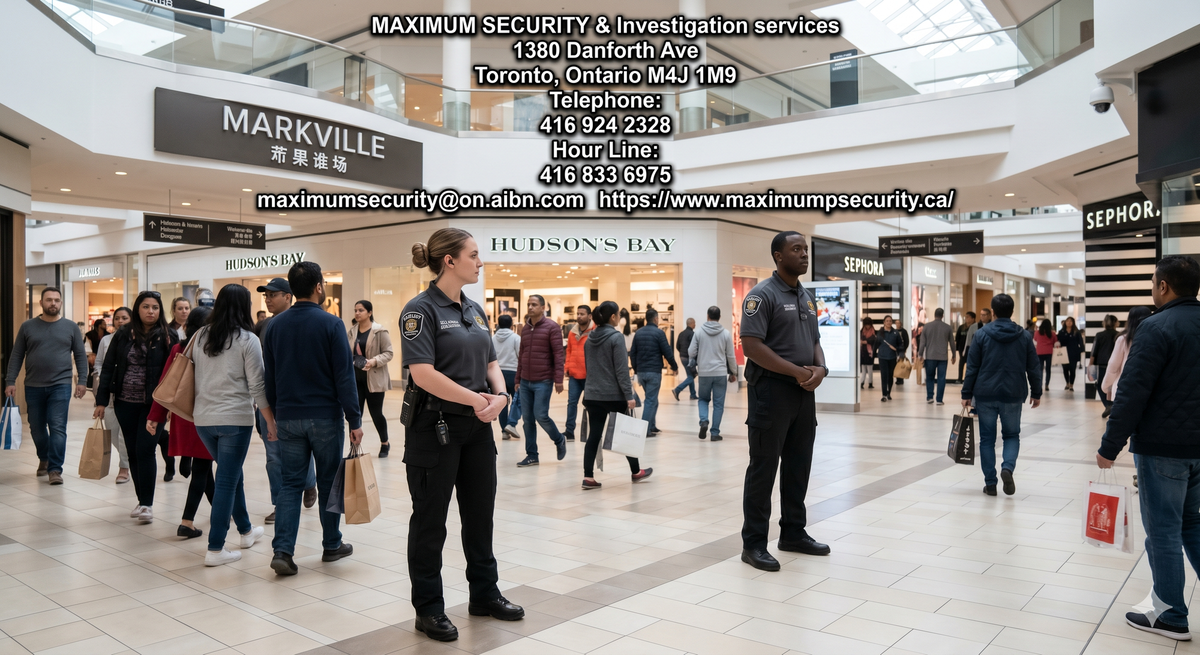
Managing the operations and profitability of a major shopping center or high-density retail power center in Markham—spanning the bustling Highway 7 commercial corridor, the dense retail hubs near Warden Avenue, or massive indoor complexes like Markville and Pacific Mall—requires an aggressive, corporate approach to loss prevention. Markham’s retail landscape is highly lucrative, drawing millions of local shoppers and international tourists annually. However, this dense concentration of luxury boutiques, high-end electronics retailers, and national anchor tenants has also made it a primary target for Organized Retail Crime (ORC) syndicates operating across York Region.
The profile of retail theft in 2026 has shifted dramatically. Corporate operations managers are no longer just dealing with opportunistic teenagers pocketing minor items; they are battling highly coordinated theft rings that use sophisticated distraction techniques, foil-lined booster bags, and staged getaway vehicles to strip thousands of dollars in high-value merchandise in mere minutes. Relying solely on internal store staff, passive electronic article surveillance (EAS) gates, or legacy camera systems is completely insufficient against these aggressive operations. For corporate retail directors and shopping center property managers, stopping the bleed requires sourcing verified B2B security vendors, deploying a mix of highly visible uniformed guards, and integrating covert plainclothes loss prevention officers (LPOs). Aligning your corporate security procurement with proven field metrics ensures your retail environment remains safe, your inventory stays on the shelves, and your commercial tenants remain highly profitable.
The Financial Reality of Organized Retail Crime in York Region
Inventory shrinkage represents a devastating, direct blow to the net operating income (NOI) of both individual retail tenants and the overarching commercial property management group. When a shopping center develops a reputation for high theft rates or aggressive loitering, the economic damage cascades through the entire corporate ecosystem.
Consensus Analysis: In-House Staffing vs. Outsourcing to B2B Security Vendors
When corporate retail operations managers build out their annual loss prevention budgets, they must decide between hiring internal, proprietary security staff or outsourcing the function to a specialized, licensed B2B security agency.
The Verdict:
- Avoid This: Relying on standard retail employees or an in-house team of under-trained, proprietary security guards to execute high-risk loss prevention duties. Utilizing direct employees for physical security introduces massive corporate liability. If an internal employee improperly detains a suspect or uses physical force, the retail corporation faces direct, multi-million-dollar civil lawsuits for false imprisonment and assault, while also paying heavy workers' compensation premiums.
- Buy This: Outsource your primary loss prevention and storefront guarding requirements directly to a fully licensed, heavily insured commercial security agency. A verified B2B security vendor absorbs all employment liabilities, coordinates mandatory provincial licensing, provides extensive de-escalation training, and shields your core retail brand from the legal fallout of physical altercations or arrests.
Calculating the True Corporate Overhead of Retail Shrinkage
The economic fallout of organized retail crime inside a Markham shopping center extends far past the direct wholesale invoice of a stolen luxury handbag or premium cosmetic shipment. Frequent, unchecked theft creates a highly stressful environment for front-line retail workers. When store employees feel unsafe challenging aggressive ORC groups, staff morale plummets, resulting in high employee turnover. Corporate HR departments are forced to spend thousands of dollars continuously recruiting, onboarding, and training replacement staff.
Furthermore, if a commercial shopping center fails to provide a secure common area, major national anchor tenants will cite breaches in their lease agreements and relocate to competing properties. Replacing a flagship anchor tenant in Markham can take years and cost millions in lost rent and tenant improvement allowances.
| Corporate Loss Component | Unsecured Retail Center Environment | Fortified B2B Guard Deployment |
|---|---|---|
| Direct Inventory Asset Loss (Monthly) | $25,000 - $65,000+ (CAD) | $0.00 (Theft Deterred/Intercepted) |
| Employee Turnover & Corporate HR Costs | $12,000 (CAD) | $0.00 (Stable Workplace Environment) |
| Commercial Liability & Legal Deductibles | $25,000+ per civil incident | $0.00 (Outsourced Liability) |
| Anchor Tenant Lease Turnover Risk | Severe structural revenue threat | $0.00 (Stable, Secure Tenancy) |
| Total Estimated Financial Impact | $62,000 - $102,000+ (CAD) | $0.00 |
By partnering with a professional commercial security firm, operations managers transform loss prevention from a volatile liability center into a predictable, fixed operational expense. Retail managers looking to understand how these procurement principles scale across different commercial frameworks should review our foundational manual on 2026 construction site security guidelines for GTA contractors to verify baseline risk management workflows that apply across all corporate properties.
Engineering an Advanced B2B Loss Prevention Framework
Eliminating organized retail crime in a massive commercial complex requires a dynamic, multi-layered security architecture. You must balance the need for aggressive asset protection with the requirement to maintain a welcoming, premium shopping environment for legitimate consumers.
1. The High-Visibility Uniformed Deterrent
Your primary line of defense against both organized theft and general property mischief is a highly visible, uniformed security presence. Deploy sharp, customer-service-oriented guards at all primary mall entrances, central concourses, and directly outside high-risk anchor tenants (such as high-end electronics stores, pharmacies, and luxury apparel retailers).
This visible presence serves an immediate psychological function. Organized retail thieves calculate risk rapidly; when scout teams spot a highly professional, alert uniformed guard monitoring a concourse, they typically abandon their operational plan and move their focus to an unsecured strip mall. For properties evaluating specialized guarding models to protect premium retail without compromising aesthetics, incorporating the protocols in our guide on uniformed loss prevention guards for luxury retail in Yorkville provides excellent context for high-end storefront protection.
2. Covert Plainclothes Loss Prevention Officers (LPOs)
While uniformed guards deter crime from happening, they are rarely positioned to execute legal arrests because thieves simply wait until the guard walks away. To actively interdict theft rings and recover stolen merchandise, corporate operations managers must deploy plainclothes Loss Prevention Officers (LPOs).
LPOs blend seamlessly into the shopping environment, posing as ordinary customers. They utilize advanced behavioral profiling to identify suspicious individuals—such as groups carrying unbranded, oversized shopping bags, individuals avoiding eye contact with staff, or those wearing unseasonal, heavy clothing designed to conceal merchandise. Once an LPO identifies a target, they execute continuous, covert surveillance, tracking the suspect through the store until the legal parameters for a citizen's arrest are fully satisfied.
3. Securing the Exterior with Randomized Mobile Patrols
A shopping center's security perimeter does not end at the glass doors. Massive, multi-level parking garages and rear shipping laneways are notorious hotspots for organized theft groups staging getaway vehicles, executing illicit cargo transfers, or conducting late-night break-ins.
To secure these vast exterior zones affordably, integrate a dedicated mobile security patrol service. A professional patrol officer in a marked, GPS-tracked security vehicle arrives at the property at unpredicted intervals to sweep the parking lots, check rear loading dock doors, and ensure no unauthorized vehicles are idling near emergency exits. Property managers looking to evaluate the performance metrics between static coverage and shared vehicle services should study our comprehensive breakdown on hiring live guards vs. mobile patrols for Vaughan residential developments to optimize multi-site protection budgets.
B2B Procurement: Sourcing Verified Commercial Guarding in Markham
Acquiring professional security guard coverage for a Markham shopping center requires a realistic understanding of corporate agency pricing structures across Southern Ontario. Corporate operations managers cannot evaluate security proposals based on minimum-wage expectations. In the 2026 Ontario market, a legitimate, compliant security agency must operate under the strict guidelines of the Private Security and Investigative Services Act (PSISA), pricing contracts to cover massive corporate infrastructure, including multi-million-dollar commercial general liability insurance, WSIB clearings, and 24/7 centralized dispatch desks.
For active commercial shopping centers and retail power centers across Markham, corporate procurement teams should budget for the following agency bill rates:
- Static Uniformed Concierge Guard (Tier 1): Billed at $38.00 to $48.00 per hour (CAD). This involves a highly visible, customer-service-oriented guard executing continuous foot patrols along the central concourses, managing visitor inquiries, and enforcing property rules.
- Covert Loss Prevention Specialist / LPO (Tier 2): Billed at $45.00 to $58.00 per hour (CAD). This involves a plainclothes operative with advanced legal arrest training, conflict de-escalation certification, and deep knowledge of Criminal Code arrest frameworks. Ideal for direct deployment inside high-shrinkage anchor tenants.
- Randomized Mobile Vehicle Patrol (Tier 3): Billed at $45.00 to $75.00 per individual site check (CAD). This option provides unpredicted, thoroughly documented vehicle sweeps for your parking garages and rear laneways, ensuring getaway vehicles cannot stage effectively.
Hiring an organization that quotes rates significantly below these commercial baselines—such as $22.00 to $25.00 per hour—is a direct indication that the provider is cutting critical compliance corners, operating without WSIB clearance, or failing to carry proper commercial liability insurance. If an uninsured guard injures a shoplifter on your property, your corporate real estate group will bear 100% of the legal liability. To understand how to avoid these procurement traps, reviewing our guide on hiring uniformed security guards for retail plazas in Brampton is an essential step for any operations director.
If your corporate shopping center, specialty retail hub, or heavy-traffic indoor mall in Markham requires an unyielding line of defense to eliminate inventory shrinkage and protect your commercial tenants, establishing professional protection is straightforward. Corporate operations managers can easily connect with verified B2B operators to request a custom security quote from Maximum PI Security to deploy certified personnel, execute covert interdictions, and secure valuable commercial assets against organized threats.
Navigating the Legal Frameworks of Retail Arrests
Deploying private loss prevention officers within a commercial environment requires absolute, unwavering adherence to Canadian law. The primary objective is to recover corporate assets without exposing the retail brand to civil lawsuits for false arrest or assault.
Under section 494 of the Criminal Code of Canada, a licensed security guard (acting as an authorized agent of the property owner) possesses the legal power to execute a citizen's arrest if they witness an individual committing an indictable offense—such as theft. However, to legally execute an arrest for shoplifting, the LPO must maintain continuous, unbroken surveillance of the suspect to establish the following five legal steps:
- Selection: Witness the suspect select the item directly off the retail display.
- Concealment: Witness the suspect conceal the item within their clothing, a booster bag, or an accomplice's bag.
- Continuous Observation: Maintain uninterrupted visual surveillance of the suspect throughout their entire time on the sales floor. If the LPO loses sight of the suspect for even three seconds behind a pillar, the arrest must be aborted, as the suspect may have dumped the merchandise.
- Failure to Pay: Witness the suspect deliberately bypass all open cash registers and points of sale.
- Exit: Intercept the suspect completely outside the store perimeter (the vestibule or exterior sidewalk) to definitively prove their intent to deprive the owner of the property.
If a guard strictly adheres to these five steps, the arrest is legally sound, ensuring a smooth handover to the York Regional Police and a high probability of successful prosecution. Sourcing security through a verified firm adhering to these strict legal baselines is the ultimate risk-management step. For independent businesses looking to implement localized versions of these strategies, reviewing our neighborhood guide on Danforth Ave business security: stopping shoplifting and store vandalism provides excellent context on managing localized crime without massive corporate budgets.
Nitty-Gritty LP Operational Realities
Can shopping centers use Automated License Plate Recognition (ALPR) cameras to track known ORC vehicles?
Yes. With the recent push under Ontario’s "Protecting Ontario's Streets and Communities Act, 2026," there is a heavy emphasis on tracking organized crime vehicles. Commercial shopping centers can legally install ALPR cameras at their main parking garage entrances. These systems instantly scan incoming plates and cross-reference them against internal databases of vehicles known to be associated with organized retail crime rings or previous fleeing suspects. If a flagged plate enters the property, the system silently alerts the centralized security desk, allowing LPOs to deploy to the storefront before the suspects even exit their vehicle. However, clear public signage indicating the presence of recording equipment must be displayed to comply with provincial privacy laws.
What is the protocol when an ORC "flash mob" hits a retail store?
When a large, coordinated group of 10 to 20 individuals rushes a store simultaneously to grab merchandise (a "flash mob" or "steaming" tactic), standard arrest protocols are immediately suspended. A single LPO or uniformed guard cannot safely interdict a mob. The strict operational protocol is immediate physical de-escalation: the guard must prioritize the physical safety of store employees and customers by moving them away from the aisles, avoiding any physical blockage of the exits, and instantly triggering a direct panic alarm to dispatch the York Regional Police Hold-Up or Major Theft units. The guard focuses entirely on capturing high-resolution video evidence and noting vehicle descriptions for post-incident prosecution.
Are LPOs allowed to put hands on a shoplifter if they try to run away?
While section 494 of the Criminal Code allows for an arrest using "as much force as is necessary," top-tier commercial B2B security agencies operate under strict "hands-off" or "minimal force" policies to mitigate civil liability and protect staff. If an LPO intercepts a suspect outside the store and the suspect drops the merchandise and runs, the LPO will absolutely not tackle, chase, or physically wrestle them to the ground. The corporate objective is asset recovery, not vigilante justice. The LPO will secure the dropped merchandise, document the suspect’s description, and file a formal report. Physical restraint is only utilized if the suspect becomes violent and poses an immediate physical threat to the officer or the public.

Frequently Asked Questions
What are the peak times for organized retail crime in Markham shopping centers?
Field data indicates that organized retail theft groups selectively target large shopping centers during mid-afternoon windows (between 2:00 PM and 5:00 PM) when mall concourses are highly congested with after-school traffic, or during the final hour before closing when staffing levels are reduced and employees are distracted by closing duties.
How does the Trespass to Property Act (TPA) help loss prevention?
The Ontario Trespass to Property Act allows property managers and their contracted guards to formally ban individuals from the shopping center. If an LPO intercepts a shoplifter, or if a uniformed guard catches a scout team mapping out a store, they can issue a formal Notice of Trespass. If that individual ever returns to the mall property—even if they haven't stolen anything yet—they can be immediately arrested for trespassing, effectively neutralizing their ability to target your tenants in the future.
Why is coordinating with local law enforcement critical for B2B security vendors?
Organized retail crime is not isolated to a single mall. A crew that hits a pharmacy in Markham today will hit a similar store in Vaughan tomorrow. Professional B2B security agencies build strong data-sharing partnerships with units like the York Regional Police Major Theft Prosecution Response Team. By sharing high-resolution CCTV footage, license plates, and suspect profiles across a centralized network, isolated shoplifting incidents are escalated into major criminal syndicate prosecutions.
About the Author
Jeff Calixte is an online exclusive content sell strategist with a deep background in tracking local asset protection data, analyzing Southern Ontario labor rates, and outlining real operational deployment structures across the Greater Toronto Area.
Sources
- Criminal Code of Canada, R.S.C. 1985, c. C-46 - Section 494 Arrest Standards
- Ontario Ministry of the Solicitor General - Private Security and Investigative Services Act Regulations
- York Regional Police - Commercial Property Protection and Retail Crime Initiatives
Note
Commercial bill rates, guard wages, deployment conditions, and vendor availability can vary widely by province, municipality, season, and project scope. All pricing estimates, labor figures, and career examples in this guide are approximations based on current Ontario market data. Always confirm contract details, licensing compliance, and specific rate quotes directly with your chosen service provider or employer before finalizing any agreements.