Danforth Ave Business Security: Stopping Shoplifting and Store Vandalism
Independent retailers and restaurants along Danforth Avenue are facing unprecedented inventory shrinkage and late-night property damage. Discover the exact commercial guarding strategies and loss prevention tactics designed to protect storefronts in East York.
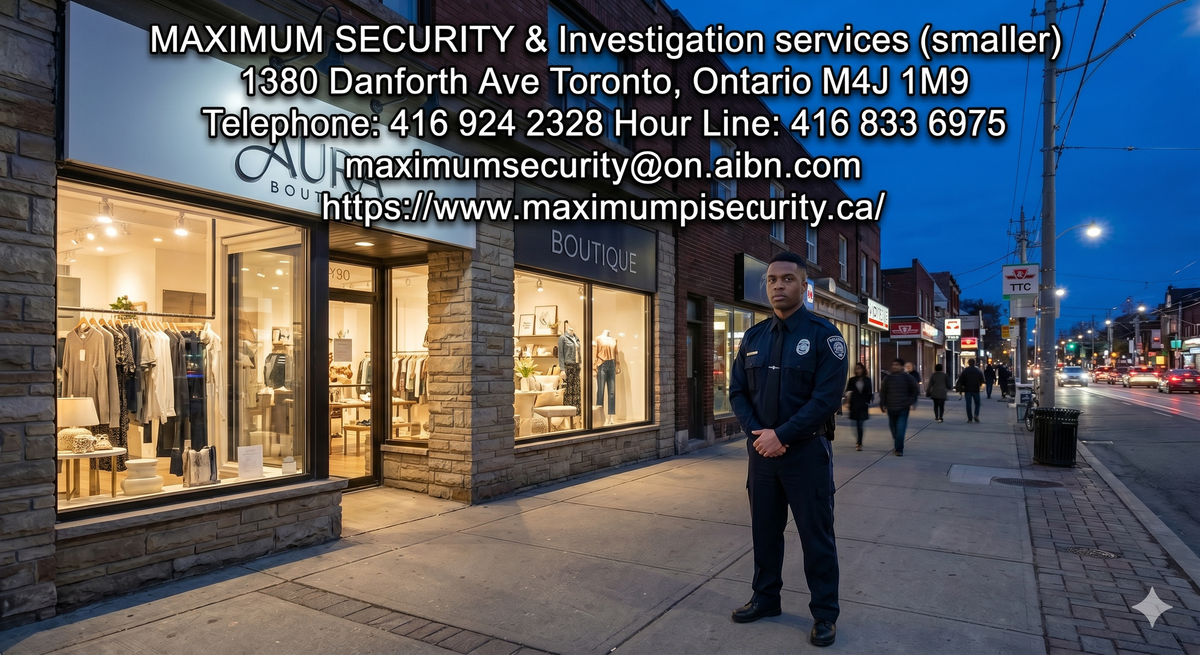
Operating an independent business, boutique retail storefront, or high-traffic restaurant along Danforth Avenue—stretching through the heart of Greektown, past Pape and Donlands, all the way to Coxwell and Woodbine—offers incredible access to one of Toronto's most vibrant commercial corridors. However, this high daily foot traffic also exposes local business owners to a severe and escalating wave of retail shrinkage, aggressive shoplifting, and late-night property vandalism. Whether you operate a specialty electronics store near 1380 Danforth, a local pharmacy, or a family-owned grocery market, the profile of retail crime has shifted. It is no longer just opportunistic theft; organized retail crime networks are actively targeting East York businesses to strip high-value inventory from shelves in broad daylight, while late-night vandals target rear laneways and glass storefronts after closing hours.
Relying on legacy security methods—such as passive overhead mirrors, unmonitored security cameras that only record individuals wearing face coverings, or standard glass-break alarms that alert police long after the intruders have fled—leaves your operational margins completely exposed. For a Danforth retail operator, restaurant manager, or local property owner, protecting your livelihood requires an active, physical deterrent strategy. Deploying highly trained, uniformed retail security personnel allows businesses to reclaim their sales floors, deter organized theft syndicates immediately, protect front-line retail staff from aggressive encounters, and maintain a safe, welcoming shopping environment for paying customers in the local community.
The Financial Reality of Retail Shrinkage on the Danforth
Inventory shrinkage represents a devastating blow to the tight profit margins of independent businesses operating along the Danforth. When a retail store loses high-ticket inventory out the front door, the business cannot simply absorb the loss; the owner must generate thousands of dollars in additional, unbudgeted sales just to recover the raw wholesale cost of the stolen merchandise.
Consensus Analysis: Passive Electronic Sensors vs. Visible Uniformed Guards
When local business owners evaluate their loss prevention budgets, they frequently debate whether to invest in advanced electronic article surveillance (EAS) pedestals at the front door or to deploy a visible, uniformed security presence.
The Verdict:
- Avoid This: Relying exclusively on passive electronic security tags and door buzzers. Organized retail crime groups routinely utilize foil-lined booster bags or handheld magnetic detachers that completely bypass electronic sensors without triggering a single alarm, allowing them to walk right out onto the Danforth undetected. Furthermore, a ringing alarm does nothing if your staff is too busy or too intimidated to stop the suspect.
- Buy This: Station a professional, crisply uniformed security guard directly at the primary storefront entrance and exit zones during peak operating hours. A highly visible human presence creates an immediate psychological barrier for shoplifters, disrupting their exit strategy and forcing theft groups to completely bypass your storefront in favor of softer, unmonitored targets elsewhere in the neighborhood.
Deep Dive: Calculating the True Overhead of Storefront Crime
The true financial impact of retail theft extends far past the direct invoice cost of a stolen designer jacket, specialized cosmetic product, or premium electronic device. When a Danforth retail location becomes known as a frequent, easy target for open shoplifting, the entire operational health of the business declines rapidly.
Frequent, unchecked theft creates a highly stressful and unsafe environment for your retail workers, driving high employee turnover rates and drastically increasing corporate recruitment and training expenses. If store staff feel unsafe challenging aggressive shoplifters, morale plummets, which directly leads to lower customer service standards and declining overall sales volumes. Moreover, late-night vandalism—such as smashed front display windows or severely tagged rear loading doors—requires emergency board-up services and expensive glass replacements before the store can safely reopen to the public the next morning.
| Store Loss Component | Unsecured Danforth Retail Environment | Fortified Uniformed Guard Layout |
| Direct Inventory Asset Loss (Monthly) | $2,500 - $6,000 (CAD) | $0.00 (Theft Deterred) |
| Emergency Glass Repair & Remediation | $1,200 - $3,500 (CAD) | $0.00 (No Vandalism Sustained) |
| Employee Turnover & Re-Hiring Costs | $4,500 (CAD) | $0.00 (Stable Workplace) |
| Commercial Liability/Insurance Claims | Premium spikes, high deductibles | $0.00 (Maintained Clean Record) |
| Customer Foot Traffic Decline | Estimated 10% drop in local sales | $0.00 (Maintained Community Trust) |
| Total Estimated Financial Impact | $8,200 - $14,000+ (CAD) | $0.00 |
Furthermore, if an independent retailer relies on untrained staff to intercept or physically stop shoplifters, the business faces massive legal liabilities. Improperly handling a suspected shoplifter can trigger severe civil lawsuits against the store owner for false imprisonment, defamation, or personal injury, with legal deductibles and settlement fees routinely exceeding tens of thousands of dollars. Investing in professional, licensed guarding assets is a predictable, mathematically superior approach that protects your corporate bottom line while shielding your business from devastating legal exposures.
Business owners looking to understand how these storefront security principles integrate with broader commercial protection guidelines across the city should review our foundational manual on 2026 construction site security guidelines for GTA contractors to verify baseline risk management frameworks that apply across all commercial property types.
Engineering an Ironclad Storefront Defense Strategy
Eliminating organized retail crime and store vandalism along Danforth Avenue demands a strategic, active security layout that addresses vulnerabilities during both peak daytime operational hours and late-night closing buffers.
1. First-Impression Deterrence at the Primary Entrance
Your primary retail security asset must be positioned carefully to maximize their visual deterrence. Station your uniformed guard within the immediate entrance foyer, directly adjacent to the main cash wraps and front display windows. This positioning provides the guard with a complete, unobstructed line of sight across the entire sales floor and main entry points facing the busy Danforth sidewalk.
The presence of a sharp, alert security officer signals to every visitor that the store is actively managed and protected. For premium retail locations or local boutique storefronts seeking an elite, professional human presence to protect luxury inventory without compromising high-end customer service standards, incorporating specialized guarding models like those detailed in our guide on uniformed retail security guards and shoplifting deterrence strategies for 2026 provides excellent context for structuring your front-of-house protection.
2. Implementing "De-Escalation First" Tactical Frameworks
Modern retail security guards deployed on busy streets like the Danforth must prioritize advanced verbal de-escalation techniques over physical force. When an incident occurs on the sales floor—such as a disruptive customer or a group of teenagers causing a disturbance—a trained guard uses non-threatening body language and professional verbal commands to contain the situation quickly before it can escalate into a dangerous physical altercation.
If a suspect attempts to exit the store with concealed merchandise, the guard acts as a calm, authoritative presence. They request the return of the store's property politely yet firmly, allowing the business to recover its inventory safely while minimizing disruptions to paying customers. If a suspect becomes highly aggressive, the guard knows exactly how to disengage safely, document the suspect’s physical description, and coordinate immediately with the Toronto Police Service's 55 Division, ensuring the safety of your staff always remains the absolute highest priority.
3. Securing Rear Laneways with Randomized Mobile Audits
Many businesses along the Danforth feature a dual-exposure layout: a primary storefront facing the main avenue, and a rear loading dock or staff entrance facing a dark, narrow back laneway. These rear laneways are notorious hotspots for late-night vandalism, illegal dumping, graffiti tagging, and opportunistic break-and-enters targeting rear steel doors.
For retail operations where budgets cannot support a permanent, full-time static security presence overnight, integrating a dedicated mobile security patrol service is an exceptional alternative. A professional patrol officer in a marked security vehicle arrives at your rear laneway at completely randomized intervals throughout the high-risk overnight closing windows. During each site visit, the officer manually checks perimeter doors, monitors rear parking areas for suspicious loitering, and ensures that delivery bays remain completely secure. The unpredictable nature of these checks thoroughly disrupts the planning of local smash-and-grab groups. Property managers looking to evaluate the performance metrics between static coverage and shared vehicle services should study our comprehensive breakdown on hiring live guards vs. mobile patrols for Vaughan residential developments to optimize multi-site protection budgets.
Commercial Procurement: Sourcing Verified Retail Guarding
Acquiring professional security guard coverage for an East York storefront requires a realistic understanding of commercial agency pricing structures across Southern Ontario. Store managers often make the mistake of evaluating security proposals based on basic minimum-wage expectations, completely overlooking the substantial corporate infrastructure required to operate a legitimate, fully licensed security guard business. In the 2026 Ontario market, a compliant security agency must operate under the strict guidelines of the Private Security and Investigative Services Act (PSISA), pricing contracts to cover extensive corporate overhead, including multi-million-dollar commercial general liability insurance, comprehensive WSIB clearings, vehicle fleet maintenance, and 24/7 centralized command centers.
For active retail operations or local business strips along the Danforth, commercial procurement teams should budget for the following agency bill rates:
- Static Uniformed Retail Guard (Tier 1): Billed at $38.00 to $48.00 per hour (CAD). This involves a highly visible, customer-service-oriented guard stationed continuously at your storefront during business hours, executing floor patrols, and maintaining a digital incident logbook.
- Elite Loss Prevention Specialist (Tier 2): Billed at $45.00 to $58.00 per hour (CAD). This involves a guard with advanced legal arrest training and conflict resolution skills, ideal for high-theft electronics retailers or businesses dealing with aggressive, recurring organized retail crime rings.
- Randomized Mobile Vehicle Patrol (Tier 3): Billed at $45.00 to $75.00 per individual site check (CAD). This option provides unpredicted, thoroughly documented vehicle drop-by checks for your rear laneways and parking lots, presenting an outstanding balance of risk mitigation and cost containment for overnight hours.
Hiring an organization that quotes rates significantly below these commercial baselines—such as $22.00 to $25.00 per hour—is a direct indication that the provider is cutting critical compliance corners, leaving your local business exposed to massive legal vulnerabilities. Understanding the foundational legal frameworks outlined in construction site security guard requirements in North York can protect your business from these severe compliance failures, as the liability principles apply universally across all commercial spaces.
If your active storefront, specialty boutique, or high-traffic restaurant on the Danforth requires an unyielding line of defense to eliminate inventory shrinkage and protect staff, establishing professional protection is straightforward. Store owners can easily connect with verified field operators to request a custom security quote from Maximum PI Security to deploy certified personnel, manage primary entrances, and secure valuable inventory assets against localized threats.
Legal Realities and Compliance Under the Criminal Code of Canada
Deploying private security guards within a retail environment requires strict adherence to Canadian law and provincial regulations to protect the business from severe civil lawsuits. Under section 494 of the Criminal Code of Canada, a private security guard (acting as an authorized agent of the property owner) possesses the legal power to execute a citizen's arrest if they witness an individual committing an indictable offense—such as theft over $5,000 or severe property mischief—on or in relation to the property.
However, to legally execute an arrest for shoplifting, the security guard must maintain continuous, uninterrupted surveillance of the suspect from the exact moment they select the merchandise to the moment they clear the final point of sale without paying. The guard must establish five distinct legal steps:
- Witness the suspect select the item directly off the display shelf.
- Witness the suspect conceal the item within their clothing or a personal bag.
- Maintain uninterrupted visual surveillance of the suspect throughout their entire time on the sales floor.
- Witness the suspect deliberately bypass all open cash registers and points of sale.
- Intercept the suspect completely outside the store perimeter on the private exterior footprint.
If a guard fails to maintain continuous observation for even a few seconds, executing an arrest introduces massive legal liabilities, as the suspect may have discarded the merchandise in a blind spot. Sourcing security through a verified firm adhering to strict training baselines is a fundamental risk-management step to protect your business from unlawful detention claims.
Furthermore, guards operate under the authority of the Ontario Trespass to Property Act (TPA). This provincial legislation gives your contracted guard the explicit legal power to approach individuals loitering in your entranceways, demand they leave the premises, and formally ban repeat offenders from ever re-entering the store. Enforcing the TPA effectively removes problematic individuals from your storefront before they ever have the opportunity to commit a theft.
Nitty-Gritty Danforth Security Realities
What should a local business owner do if they find individuals sleeping or loitering in their recessed storefront entrance every morning?
Recessed doorways along the Danforth are frequent targets for overnight loitering and sheltering. If your staff encounters this situation every morning, it poses a safety risk and deters early customers. The best practice is to avoid having untrained retail staff confront these individuals. Instead, a contracted mobile patrol officer should be scheduled to perform a dedicated "unlock and clear" sweep 30 minutes before your staff arrives. The licensed officer will utilize the Trespass to Property Act to safely and professionally clear the recessed doorway, document the interaction, and ensure the entrance is completely clean and secure before your employees begin their shift.
Can a retail guard legally physically restrain a shoplifter who tries to run away?
While section 494 of the Criminal Code allows for a citizen's arrest using "as much force as is necessary," professional security agencies strictly limit physical use-of-force policies due to the massive civil liability and physical danger involved. If a shoplifter drops the merchandise and attempts to flee, the guard will absolutely not tackle or physically restrain them. The primary objective is the safe recovery of the commercial asset and the protection of innocent bystanders. Chasing a suspect down the Danforth sidewalk over a stolen cosmetic item creates an unacceptable risk of injury to the public and the guard.
Are retail stores legally responsible if an untrained cashier injures a suspect during an interception?
Yes. Under the legal principle of vicarious liability, a retail store owner can be held entirely civilly responsible for the actions of their employees operating on the premises. If a cashier or floor manager chases a suspected shoplifter and utilizes improper physical force, the store can face direct, multi-million-dollar lawsuits for personal injury, assault, and false imprisonment. This is precisely why business owners must instruct their retail staff never to intervene physically, and instead partner exclusively with professional, fully insured security agencies.

Frequently Asked Questions
What are the peak times for storefront vandalism along Danforth Avenue?
Field records indicate that the majority of storefront vandalism—including broken windows and graffiti tagging—occurs between 2:00 AM and 5:00 AM, specifically following busy weekend nights when local bars and nightlife venues let out. The heavy foot traffic combined with reduced visibility makes this the highest-risk window for property damage.
Should independent retailers utilize plainclothes loss prevention officers or visible uniformed guards?
For independent retailers and smaller boutiques along the Danforth, a highly visible, uniformed security guard is almost always the optimal choice. Plainclothes officers are excellent for building legal cases against internal employee theft rings, but they do nothing to deter a crime from happening in the first place. A uniformed guard serves as an immediate visual deterrent that stops a shoplifter before they even enter the store.
Can a security guard issue parking tickets to non-customers parking in our private rear laneway?
Yes. If your business owns a private parking pad or rear lot off a Danforth laneway, and you have the proper municipal signage displayed warning against unauthorized parking, a licensed security guard acting as your authorized agent can legally issue private property parking infractions or coordinate with licensed local towing services to remove unauthorized vehicles from your dedicated spaces.
About the Author
Jeff Calixte (MC Yow-Z) is a Canadian career researcher and digital entrepreneur who studies hiring trends, labour market data, and real entry-level opportunities across Canada. He specializes in simplifying the job search for newcomers, students, and workers using practical, up-to-date information.
Sources
- Criminal Code of Canada, R.S.C. 1985, c. C-46 - Section 494 Arrest Standards
- Ontario Ministry of the Solicitor General - Private Security and Investigative Services Act Regulations
- Trespass to Property Act, R.S.O. 1990, c. T.21
Note
Commercial bill rates, guard wages, deployment conditions, and vendor availability can vary widely by province, municipality, season, and project scope. All pricing estimates, labor figures, and career examples in this guide are approximations based on current Ontario market data. Always confirm contract details, licensing compliance, and specific rate quotes directly with your chosen service provider or employer before finalizing any agreements.