Construction Site Security Guard Requirements in North York
Property developers in North York face strict liability, insurance, and provincial compliance mandates. Discover the exact licensing, training, and 2026 commercial guarding protocols required for new builds.
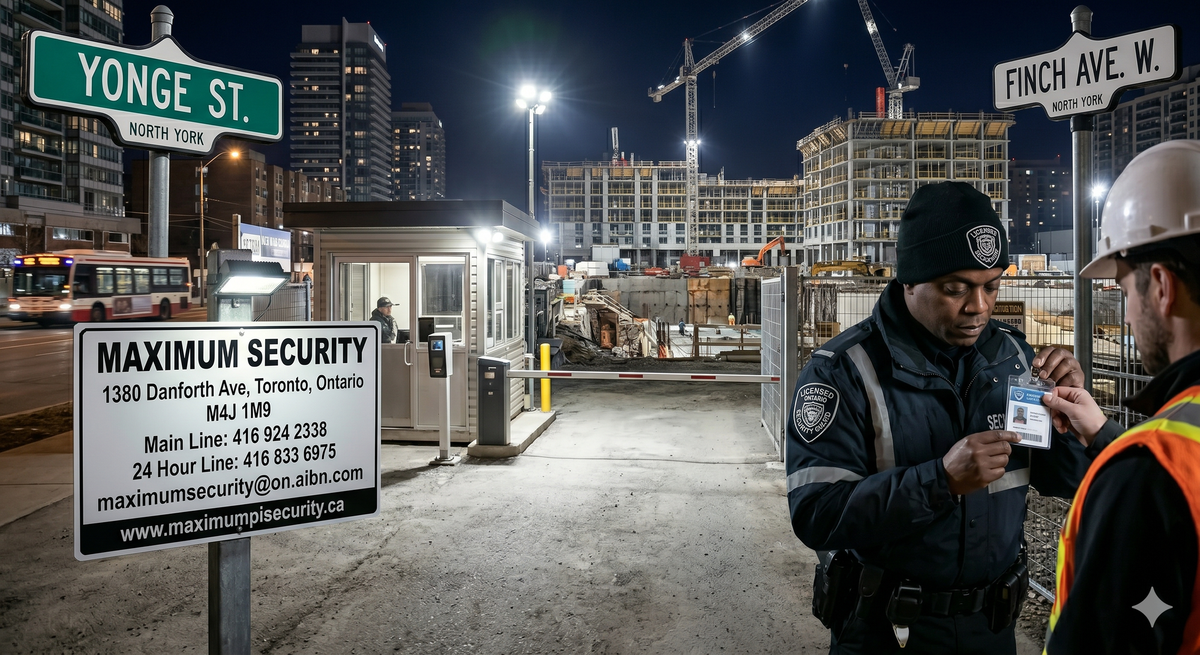
Deploying security personnel on active development projects across North York—spanning high-density residential towers near Yonge and Sheppard, commercial plazas along Steeles Avenue, or multi-phase infrastructure expansions near York University—demands full alignment with Ontario’s regulatory and liability frameworks. For property developers and general contractors, sourcing site protection is not merely an operational preference; it is a strict legal necessity driven by corporate risk management, insurance compliance, and provincial legislation. Failing to understand the specific training mandates, licensing standards, and structural coverage protocols required on local jobsites can expose your business to severe financial penalties and void your commercial general liability coverage.
Navigating the local regulatory landscape requires moving past generic safety checklists. To protect multi-million-dollar capital investments, project management teams must understand the explicit legal responsibilities enforced by the Ontario Ministry of the Solicitor General. This guide outlines the exact regulatory requirements, procurement standards, and tactical guard deployment models necessary to keep North York construction sites fully compliant and entirely secure against external threats.
Navigating the Legal Framework: The Private Security and Investigative Services Act
Every single individual performing property protection, gate access management, overnight fire watch, or site surveillance in North York must operate in absolute compliance with the Private Security and Investigative Services Act (PSISA). In Ontario, private security is a heavily regulated sector, and the province enforces uncompromising boundaries separating legitimate, licensed guard businesses from underground, non-compliant operators.
Consensus Analysis: Sub-Contracting Individual Guards vs. Partnering with Licensed Agencies
When attempting to minimize site overhead, project managers often face a choice between hiring independent, individual guards on a freelance basis or contracting an established, licensed security guard agency.
The Verdict:
- Avoid This: Hiring independent guards directly or using temporary labor agencies that supply unlicensed personnel on cash terms. Independent guards cannot legally provide security services in Ontario without holding a specialized master agency license. Operating under these gray-market arrangements instantly violates the PSISA and exposes your firm to direct regulatory prosecution.
- Buy This: Partner exclusively with a fully licensed, insured security guard business that holds a valid Ontario agency license and provides transparent, real-time access to their guards' individual licensing status. A verified agency absorbs all employment liabilities, coordinates mandatory provincial filings, and guarantees that every individual stepping onto your build site is legally authorized to execute protection duties.
The Real Cost of Compliance Failures on North York Projects
Procurement teams must recognize that cutting corners on security compliance introduces massive structural risks to a developer's balance sheet. Under the PSISA, both the provider of unlicensed security and the client who knowingly hires them can face immediate prosecution, resulting in corporate fines reaching up to $250,000.
Furthermore, the operational and financial fallout of an on-site incident involving unlicensed security personnel can entirely derail a commercial project. If an unauthorized trespasser breaches your perimeter fencing near Bathurst and Lawrence to engage in scrap metal scavenging or machinery vandalism, an unlicensed guard lacks the formal legal training required to execute proper containment protocols under the Trespass to Property Act. Should a physical altercation ensue, or if the trespasser suffers a severe injury due to uncoordinated physical intervention, your primary commercial builders' risk insurance policy will almost certainly decline the ensuing liability claim.
When an insurance carrier uncovers that a developer utilized non-compliant, unlicensed personnel to secure a commercial compound, they can legally void the policy due to a material breach of risk warranties. The primary construction company is left completely exposed to multi-million-dollar personal injury lawsuits, structural remediation overhead, and immediate stop-work orders issued by municipal building inspectors.
By implementing structured compliance monitoring and adhering to established industry pricing metrics, developers can maintain a pristine safety record. For project teams looking to balance regulatory alignment with advanced on-site loss prevention, studying localized tactical strategies like preventing overnight tool theft on East York construction sites provides excellent guidance for securing high-risk tool storage staging.
Mandatory On-Site Certifications and Training Requirements
A valid plastic security license card is merely the baseline entry requirement for personnel deployed on active North York build yards. Due to the high-hazard nature of industrial work zones, security guards must hold multiple specialized certifications to legally execute their daily patrol duties and maintain compliance with the Ontario Occupational Health and Safety Act (OHSA).
1. Working at Heights and WHMIS Certifications
If a guard’s patrol routing requires them to enter high-rise concrete structures, traverse open stairwells, or monitor multi-level parking decks, they must complete an Ontario-approved Working at Heights training program. General contractors can be held heavily liable if an agency guard suffers a slip or fall from an elevated platform without holding this active training record. Additionally, because construction yards routinely store hazardous materials, chemical solvents, and compressed gas cylinders, guards must hold up-to-date WHMIS (Workplace Hazardous Materials Information System) certification to safely navigate industrial storage compounds and properly interpret safety data sheets during an emergency.
2. Standard First Aid and CPR-AED Compliance
Ontario regulation mandates that active construction properties maintain certified first-aid personnel on the premises at all times. Professional security guards act as the primary emergency first responders during overnight or weekend windows when primary site medics are off-duty. Every guard deployed on your North York project must hold a valid Standard First Aid with CPR Level C and AED certification. This ensures that if a sub-trade worker or delivery driver suffers a medical emergency during after-hours staging, the on-site guard can provide immediate, life-saving stabilization while emergency medical services travel along busy routes like Finch Avenue or the DVP.
To ensure your broader asset protection plans integrate smoothly with these safety baselines, reviewing the fundamental operational blueprints found in our comprehensive 2026 construction site security guidelines for GTA contractors is a highly recommended step for any procurement committee.
Structuring the 2026 Procurement Budget for Compliant Sourcing
Securing fully compliant, highly trained security personnel requires a realistic alignment with current Southern Ontario commercial pricing. General contractors frequently make the mistake of evaluating security proposals based on basic minimum-wage expectations, completely overlooking the heavy corporate overhead required to maintain a legitimate, legally protected agency infrastructure. Legally operating security firms must account for mandatory employer payroll burdens, extensive WSIB insurance clearings, multi-million-dollar commercial general liability policies, specialized cold-weather patrol assets, and 24/7 centralized command centers.
For commercial builds, infrastructure expansions, or high-density residential towers across North York, developers must budget for the following market-accurate agency bill rates:
Commercial Security Sourcing Rates (North York Market)
| Service Classification | Required Guard Qualifications | Commercial Hourly Client Bill Rate (CAD) | Intended Project Application |
| Basic Static Night Guard (Tier 1) | PSISA Licensed, First Aid Certified, WHMIS Compliant, basic digital logs. | $38.00 - $48.00 / hr | Contained infill projects, small commercial renovations, and basic material yards. |
| Premium Access Control Specialist (Tier 2) | PSISA Licensed, OSHA Trained, Working at Heights Certified, manifest auditing experience. | $45.00 - $58.00 / hr | High-rise residential towers, heavy transit infrastructure, and high-traffic shipping gates. |
| Randomized Mobile Vehicle Patrol (Tier 3) | Fully equipped GPS-tracked patrol vehicle, supervisor-level officer, rapid response capability. | $65.00 - $90.00 / hr (or $45 - $75 per individual site check) | Low-risk vacant land holdings, unstaffed material storage lots, and multi-site civil roadwork. |
Hiring an organization that quotes rates significantly below these commercial baselines—such as $22.00 to $25.00 per hour—is a direct indication that the provider is cutting critical compliance corners, leaving your business exposed to massive legal vulnerabilities.
If your active project, commercial compound, or multi-family high-rise development requires an ironclad line of compliant defense that eliminates regulatory exposures, establishing professional protection is straightforward. Project superintendents and property developers can easily connect with verified field operators to request a custom security quote from Maximum PI Security to deploy certified personnel, manage primary access gates, and secure valuable capital assets against overnight liabilities.
Aligning Site Security with the Trespass to Property Act
A properly certified security guard serves as an official legal representative of the property developer or landowner. This relationship grants the guard explicit authority to enforce the provisions of the Ontario Trespass to Property Act (TPA), R.S.O. 1990. Under the TPA, your contracted guard possesses the full legal power to approach individuals attempting to compromise your perimeter, demand valid corporate identification from personnel during off-hours, deny entry to unauthorized visitors, and formally command trespassers to leave the site immediately.
To maximize the legal enforceability of the TPA and protect your site from opportunistic liabilities, the construction management firm must satisfy its own structural obligations. The entire property boundary must be enclosed by an unbroken line of commercial-grade fencing or wooden hoarding, and highly visible "No Trespassing" markers must be prominently displayed at every access gate, property corner, and street-facing boundary. If a site leaves its main gates wide open or fails to display compliant signage, establishing a clear case of unlawful entry in an Ontario court becomes exceptionally difficult, which significantly limits the ability of local police divisions to arrest or prosecute intruders caught inside your compound.
For projects facing elevated rates of property damage or malicious disruption, combining these legal protocols with specialized deterrent frameworks—such as those detailed in our guide on dealing with vandalism at Scarborough commercial build sites—ensures your perimeter remains highly defended throughout all execution phases.
The "Reddit Defense": Nitty-Gritty North York Compliance Realities
Can a North York general contractor mandate that security guards search sub-contractors' personal vehicles before they exit the site?
Yes, a developer or general contractor has the legal right to establish a "Condition of Entry" policy for their private commercial property, which can include randomized vehicle inspections to prevent internal tool and material shrinkage. However, to make this policy legally enforceable, it must be clearly outlined in the primary contracts signed by all sub-trades, and high-visibility signs detailing the vehicle search policy must be posted at every exit gate. Private security guards cannot physically force a worker to open their vehicle; however, if a worker refuses a lawful inspection, the guard can document their identity, bar them from ever re-entering the property, and immediately escalate the incident to project management for contract termination.
What happens if an agency guard is injured on-site and the security provider lacks active WSIB coverage?
This scenario represents a massive financial catastrophe for the primary contractor. If a guard trips in an unlit trench or is struck by falling material on your jobsite, and their direct employer does not maintain an active, fully paid account with the Workplace Safety and Insurance Board (WSIB), the legal immunity typically granted under Ontario law is completely shattered. The injured guard has the legal right to file a multi-million-dollar civil negligence lawsuit directly against the general contractor and the property developer. This is why you must demand a certified WSIB clearance certificate prior to shift commencement and mandate automated monthly updates from your security provider.
Are security guards legally required to wear high-visibility uniforms on active construction zones?
Yes. Under Ontario regulation and OHSA standards, any individual working within or traversing an active construction zone must wear appropriate personal protective equipment (PPE) and high-visibility clothing. Even if a guard is deployed entirely alone on an overnight shift when all machinery is turned off, they must wear CSA-approved green-patch safety boots, an approved hard hat, and a Class 2 high-visibility safety vest or jacket featuring retroreflective strips. Agencies that allow their guards to patrol dark jobsites in standard black tactical jackets are committing a direct safety violation and exposing the project to heavy Ministry of Labour fines.
Frequently Asked Questions
What specific documentation must a security guard carry while on duty in North York?
Under provincial law, every security guard must carry their original, valid Ontario Security Guard Licence card on their person at all times while on duty. They are legally required to produce this card for inspection upon the request of any member of the public, a police officer, or an investigator from the Ministry of the Solicitor General. Carrying a digital photograph or a photocopy of the license is non-compliant and can result in immediate provincial fines for both the guard and the primary contractor.
How do we verify that our overnight guards are actually performing their compliance patrols?
To guarantee that overnight guards are executing their mandatory rounds rather than remaining stationary inside an office trailer, professional agencies install digital guard tour checkpoint systems across the property. Weatherproof RFID tags or QR codes are permanently affixed to critical perimeter locations, electrical rooms, and material storage yards. The guard must physically walk to each station and scan the tag using a GPS-tracked mobile application, generating an unalterable, time-stamped digital record that is emailed directly to the project superintendent every morning.
Does an Ontario security guard license authorize a guard to carry a firearm or baton on a construction site?
An ordinary Ontario security guard license does not authorize the carry of a firearm, and firearms are strictly prohibited in the commercial guarding sector outside of specialized armored car operations. A guard may only carry a defensive baton if their direct employer holds explicit authorization to equip their personnel with intermediate weapons, and the individual guard has completed an accredited, multi-day defensive tactics and baton certification program. Carrying unauthorized or concealed weapons on a jobsite is a severe criminal offense that will result in immediate arrest and total contract termination.
About the Author
Jeff Calixte is an online exclusive content sell strategist with a deep background in tracking local asset protection data, analyzing Southern Ontario labor rates, and outlining real operational deployment structures across the Greater Toronto Area.
Sources
- Ontario Ministry of the Solicitor General - Private Security and Investigative Services Act, 2005
- Ontario Ministry of Labour - Occupational Health and Safety Act, R.S.O. 1990
- Workplace Safety and Insurance Board (WSIB) Ontario Compliance Framework
Note
Commercial bill rates, guard wages, deployment conditions, and vendor availability can vary widely by province, municipality, season, and project scope. All pricing estimates, labor figures, and career examples in this guide are approximations based on current Ontario market data. Always confirm contract details, licensing compliance, and specific rate quotes directly with your chosen service provider or employer before finalizing any agreements.