2026 Construction Site Security Guidelines for GTA Contractors
Stop bleeding your project margins to organized overnight theft rings. Discover the exact 2026 commercial bill rates, tactical guard deployments, and liability blueprints required to protect open-perimeter construction developments across the Greater Toronto Area.
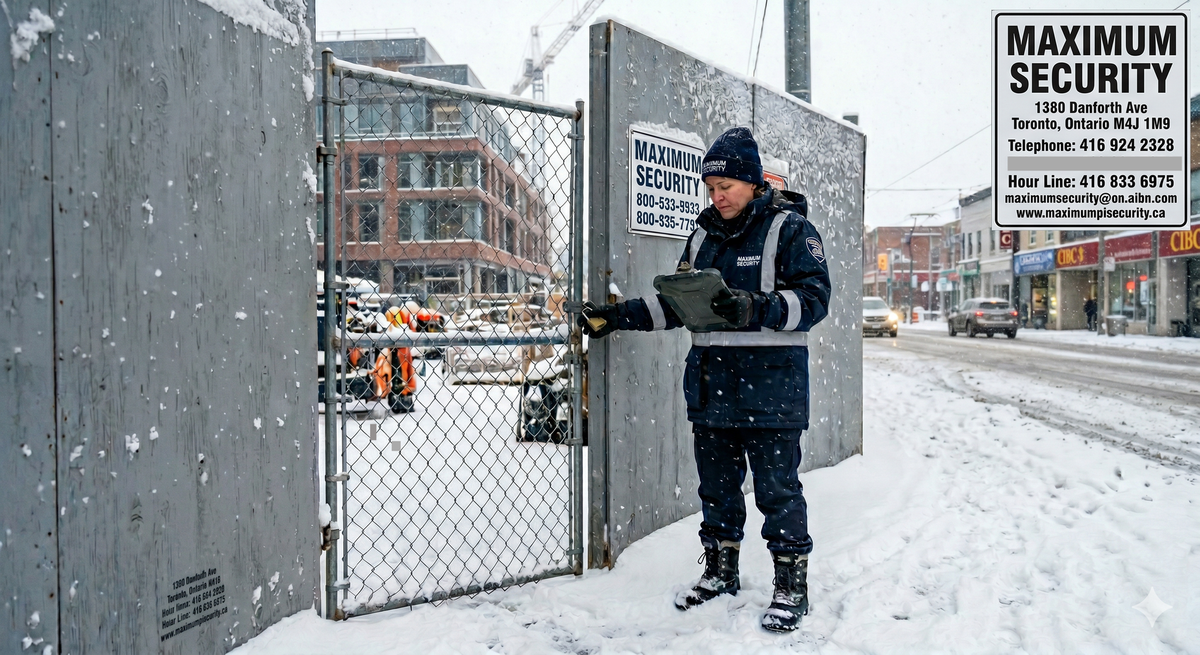
Securing open-perimeter construction sites along the Danforth, across Scarborough’s rapid transit expansion zones, or within dense downtown Toronto infill projects presents a unique set of high-liability challenges for project managers. Every fiscal quarter, GTA developers bleed tens of thousands of dollars from project budgets due to organized asset loss, stripped copper wiring, and vandalized overnight builds. Relying solely on basic chain-link fencing or unmonitored automated camera systems leaves a site completely vulnerable to sophisticated theft networks operating across Southern Ontario.
When managing a mid-rise development in Etobicoke or an extensive commercial subdivision project in North York, generic security checklists are insufficient to protect your capital. Project superintendents require localized, cold-weather-tested deployment protocols that keep projects on schedule while aligning corporate expenditure with actual 2026 Ontario commercial market costs. Protecting your job site requires evaluating procurement strategies through the eyes of an experienced analyst, establishing ironclad physical perimeters, and budgeting for professional agency deployments that deliver measurable protection.
Analyzing the Real Commercial Impact of Site Breaches
The most frequent mistake procurement officers make when sourcing site protection is viewing security as a static regulatory box to check, rather than a direct asset retention strategy. Across the GTA, the theft of raw materials—specifically framing lumber, heavy equipment components, and specialized tools—has shifted from random crimes of opportunity into highly coordinated commercial operations. Organized crime groups scout active projects during daylight hours, mapping out access points, camera blind spots, and the exact timing of perimeter guard rotations.
Consensus Analysis: Unmonitored Gates vs. Single-Point Guard Check-ins
Field data across Ontario development zones consistently demonstrates that automated, unmonitored access gates yield a 40% higher asset loss rate compared to projects utilizing single-point access check-ins managed by a live guard agency. Automated gates are routinely propped open by delivery drivers or sub-trades during busy morning windows, leaving the site exposed long after the sub-contractors have cleared out for the day.
The Verdict:
- Avoid This: Relying on automated keypad gates or remote video monitoring alone for high-traffic, multi-trade commercial builds. Remote cameras only document your losses; they do not physically intervene.
- Buy This: Deploy a dedicated access-control guard at your primary gate during operational hours to manually verify manifests, transitioning that deployment into a dedicated perimeter foot patrol immediately at tool-drop. Skip automated barriers for short-term infill projects where physical footprint manipulation is constant.
Calculating the True Cost of Procurement Decisions
Project supervisors often look strictly at the hourly invoice cost of an external security provider without calculating the cascading financial devastation of a single perimeter breach. If a commercial site in East York experiences a middle-of-the-night break-in where $10,000 worth of specialized tools and copper fittings are cleared out of a locked sea container, the immediate material loss is only a fraction of the true economic damage.
When the framing or electrical crew arrives on-site at 6:00 AM and cannot work because their essential gear or rough-in materials have been stripped, the project developer is still legally obligated to pay their scheduled trade wages. A single day of total trade downtime for a medium-sized crew can easily run between $4,000 and $8,000 in wasted labor expenditures. Contractors looking to fortify specific regions can review our specialized blueprint on preventing overnight tool theft on East York construction sites to mitigate these exact exposures.
Furthermore, filing detailed reports with the Toronto Police Service (TPS), managing the resulting commercial insurance adjustments, and paying steep deductibles will drive project costs higher. If the breach delays critical milestones—such as pouring concrete or closing up building envelopes before a heavy winter storm—the developer faces massive liquidated damages and municipal penalty clauses for missing strict hand-off deadlines. For sites facing recurring property damage or unauthorized youth access, establishing protocols like dealing with vandalism at Scarborough commercial build sites becomes an operational necessity.
Investing in a licensed overnight static guard at a standard Ontario agency bill rate is mathematically cheaper than absorbing the financial fallout of a single major yard breach. The physical presence of a clearly marked patrol vehicle and an active uniform acts as a definitive psychological deterrent that forces organized theft groups to completely bypass your project in favor of softer targets.
Decoding the 2026 Commercial Security Bill Rates (CAD)
Budgeting for security labor in the GTA requires a sharp distinction between what a security guard earns as an hourly wage and what a professional security agency must charge the client to remain compliant, insured, and operational. Some developers fall into the trap of assuming that security costs should mirror basic minimum-wage calculations. In reality, legitimate agencies must factor in heavy corporate overhead, including provincial licensing fees, massive commercial general liability insurance policies, mandatory Workplace Safety and Insurance Board (WSIB) premiums, vehicle fleet maintenance, and 24/7 centralized dispatch infrastructure.
To ensure your construction project complies with the Ontario Ministry of the Solicitor General guidelines, you must partner with an agency operating above-board. In the 2026 fiscal year, sustainable, compliant commercial bill rates across Toronto reflect these operational realities.
Commercial Security Guard Tiers & Hourly Client Bill Rates (GTA)
| Guard Tier | Coverage Specification | Commercial Hourly Client Bill Rate (CAD) | Optimal Project Application |
| Tier 1: Basic Static Guard | Overnight perimeter observation, fire watch logs, gate locks, and digital incident reporting. | $38.00 - $48.00 / hr | Small-scale residential builds, contained infill lots, and low-risk urban developments. |
| Tier 2: Premium Access Control | High-traffic daytime gate management, sub-trade manifest logging, delivery verification, and safety compliance enforcement. | $45.00 - $58.00 / hr | Major mid-rise/high-rise condo projects, heavy infrastructure builds, and sprawling commercial plazas. |
| Tier 3: Dedicated Mobile Patrol | Randomized interval vehicle sweeps, perimeter fence integrity checks, and rapid alarm response integration. | $65.00 - $90.00 / hr (or $45 - $75 per individual site visit) | Multi-phase housing subdivisions, vacant land holding zones, and distributed municipal roadwork sites. |
The "Lowest Bidder" Financial Trap
When procurement managers attempt to cut corners by hiring cut-rate security operations quoting unfeasibly low bill rates—such as $22.00 to $25.00 per hour—they are stepping directly into a massive liability trap. Given Ontario's mandatory employer payroll taxes, WSIB clearings, and standard insurance overhead, a business cannot legally operate a commercial security deployment at those margins.
Agencies charging those rates are almost universally cutting corners by deploying unlicensed guards, operating without valid WSIB coverage, or failing to carry the necessary multi-million-dollar commercial liability policies required for active construction zones. If an under-trained, unlicensed guard is injured while traversing a muddy, unlit trench on your Etobicoke job site, and the security provider lacks proper WSIB standing, the primary construction contractor can be held directly liable for millions of dollars in medical and regulatory claims. Understanding the foundational legal frameworks outlined in construction site security guard requirements in North York can protect your business from these severe compliance failures.
Always demand a certified WSIB clearance certificate and a valid certificate of insurance showing active coverage before allowing any external security guard provider to sign into your site logbook.
Winter Security Logistics: Battling -20°C Toronto Blizzards
Securing an active construction site during a mild summer month is simple compared to managing a site during a harsh Southern Ontario winter. When a severe winter storm hits the GTA, bringing accumulation and dropping temperatures down to -20°C—with wind chills plunging past -30°C near open lakefront developments or vast Scarborough expanses—your security deployment strategy must adapt immediately to maintain site integrity.
Expectations must remain practical. A guard cannot safely execute continuous, unbroken foot patrols in a freezing blizzard without facing frostbite or exposure risks. If your site lacks appropriate infrastructure, guards will naturally look for makeshift shelter, which severely degrades their situational awareness and leaves your perimeter unmonitored.
Consensus Analysis: On-Site Guard Shacks vs. Vehicle Idling
A frequent point of friction between project managers and security providers is determining the appropriate winter shelter setup for overnight personnel. Many builders refuse to provide dedicated enclosures, telling guards to observe the site from their personal vehicles.
The Verdict:
- Avoid This: Forcing guards to sit inside idling personal passenger vehicles for a 12-hour overnight winter shift. Idling vehicles face rapidly depleting fuel tanks, fogged windows that completely block peripheral vision, mechanical breakdowns, and dangerous carbon monoxide accumulation risks. Furthermore, a guard sitting in a comfortable car seat with a heater blasting is highly susceptible to falling asleep during critical midnight windows.
- Buy This: Rent an insulated, elevated, and centrally located guard shack featuring 360-degree windows and a secure electric baseboard heater. Position this structure directly at your primary asset storage choke point. This setup ensures your guard remains warm, alert, professional, and capable of maintaining unhindered visual surveillance across the entire property throughout the worst winter storms.
If your commercial project or high-density residential build requires immediate, elite protection that stands up to severe local operational realities, you can easily secure an unyielding line of defense. Property managers can seamlessly connect with proven field operators to request a custom security quote from Maximum PI Security to protect valuable machinery, establish strict gate controls, and eliminate vulnerability points before they turn into costly project overruns.
Regulatory Compliance and the Trespass to Property Act
Every deployment must operate cleanly within provincial legal frameworks to protect the developer from civil lawsuits and regulatory fines. In Ontario, a private security guard acts directly as an agent of the property owner or primary tenant. This means their operational authority on a job site is derived explicitly from the Trespass to Property Act (TPA), R.S.O. 1990.
Under the TPA, your deployed guard possesses the full legal right to challenge anyone attempting to breach the perimeter hoarding, demand valid identification from personnel after hours, deny entry to unauthorized individuals, and formally direct trespassers to leave the premises immediately. If an individual refuses to comply with a lawful command to leave, the guard has the legal right to apprehend the individual under the citizen's arrest provisions of the Criminal Code of Canada.
However, professional security management demands risk mitigation. Guards are trained to understand that they are not public police officers. If a determined trespasser or an aggressive group of copper thieves refuses to leave and displays weapons or threatening behavior, the guard’s strict protocol is to immediately retreat to a position of safety, maintain visual tracking from a distance, and instantly activate emergency dispatch protocols with the Toronto Police Service or regional authorities. Developers can contrast these comprehensive legal guidelines against alternative setups by reviewing our strategic guide on hiring live guards vs. mobile patrols for Vaughan residential developments to optimize coverage metrics.
To ensure the TPA is fully enforceable, construction companies must fulfill their own legal obligations. The entire site perimeter must be fully enclosed by unbroken fencing or hoarding, and high-visibility "No Trespassing" signage must be clearly posted at every gate, corner, and potential approach vector. If a site leaves its main gates wide open with no restrictive signage, proving unlawful entry in an Ontario court becomes incredibly difficult, severely limiting the ability of local law enforcement to prosecute intruders.
Nitty-Gritty Construction Security Truths
What happens if an overnight guard fails to show up for their scheduled shift?
This is an absolute nightmare scenario for a construction superintendent. If you have hired a low-cost, unverified agency that doesn't utilize automated check-in software, you may not find out your site was completely unguarded until you walk through the gates at 6:00 AM and find your equipment boxes pried open. Premium agencies utilize centralized, 24/7 live tracking desks where guards must digitally sign in via GPS-verified mobile apps 15 minutes prior to their shift. If a guard fails to check in, the system instantly alerts a mobile patrol supervisor, who is dispatched immediately to hold the perimeter until a backup static guard arrives. Always demand to see an agency’s live tracking and backup protocol before signing a vendor agreement.
Are private security guards on construction sites legally permitted to use physical force?
A licensed guard may only use a reasonable, necessary amount of physical force to defend themselves from an active assault or to prevent a felony crime from occurring on the property they are contracted to protect. Legally, a guard cannot use physical force to protect raw materials or tools if the intruder is attempting to flee the area. The consensus among risk management experts is clear: guards should avoid physical altercations over physical property. The primary role of a professional security deployment is to observe, document, and deter through high-visibility positioning and immediate law enforcement escalation.
Can we save money by just paying our own site laborers cash to stay overnight?
Doing this violates provincial law in Ontario. Under the Private Security and Investigative Services Act (PSISA), any individual who performs property protection, overnight watch, or access control duties must be explicitly licensed by the Ministry of the Solicitor General. If you pay an unlicensed construction laborer to sit in a trailer overnight, and that individual is injured during a robbery, your corporate insurance policies will be rendered completely void. Your business will face massive structural fines from the Ministry and potentially devastating workplace safety lawsuits. Every individual watching your property must hold an active, valid Ontario security license card.

Frequently Asked Questions
How many security guards are required to protect a standard multi-acre subdivision build?
For a typical single-block downtown condo infill or a tight commercial build, a single well-positioned static guard stationed at the main access gate is sufficient. However, for large, sprawling residential subdivisions covering multiple acres with open perimeters, a single guard cannot cover the ground effectively. These larger projects require a hybrid deployment model consisting of one fixed static guard managing the primary material storage yard and trailer compound, reinforced by a secondary mobile patrol unit executing randomized vehicle sweeps across the outer perimeters at regular intervals throughout the night.
What exactly is a construction fire watch, and when is it legally mandated?
A construction fire watch is a specialized, continuous manual patrol mandated by the Ontario Fire Code. It is legally required whenever a building’s permanent fire alarm system, standpipe, or automated sprinkler network is temporarily shut down, undergoes maintenance, or has not yet been fully commissioned during the final stages of a commercial build. The security guard must perform continuous rounds throughout every floor of the structure, logging their physical presence at specified tracking stations every 30 to 60 minutes, and maintaining meticulous, time-stamped written records to present to municipal fire inspectors upon demand.
What specific personal protective equipment (PPE) must a security guard wear on-site?
Even if a guard is only deployed after hours when active construction has ceased for the day, they remain fully bound by Ontario Occupational Health and Safety Act (OHSA) regulations. While inside the site perimeter, a guard must continuously wear CSA-approved green-patch safety footwear, a high-visibility reflective class-2 safety vest or jacket, and an approved hard hat if any overhead hazards or material storage risks remain active on the property.
About the Author
Jeff Calixte is an online exclusive content sell strategist with a deep background in tracking local asset protection data, analyzing Southern Ontario labor rates, and outlining real operational deployment structures across the Greater Toronto Area.
Sources
- Ontario Ministry of the Solicitor General - Private Security and Investigative Services Act Guidelines
- Trespass to Property Act, R.S.O. 1990, c. T.21
- Ontario Fire Code Regulations & Municipal Fire Watch Standards
Note
Commercial bill rates, guard wages, deployment conditions, and vendor availability can vary widely by province, municipality, season, and project scope. All pricing estimates, labor figures, and career examples in this guide are approximations based on current Ontario market data. Always confirm contract details, licensing compliance, and specific rate quotes directly with your chosen service provider or employer before finalizing any agreements.