Festival and Outdoor Event Crowd Control Security in Mississauga
Organizing an outdoor festival at Celebration Square or Port Credit requires rigid crowd management. Discover the advanced perimeter fencing strategies, liquor license enforcement tactics, and emergency evacuation protocols needed to secure Mississauga events.
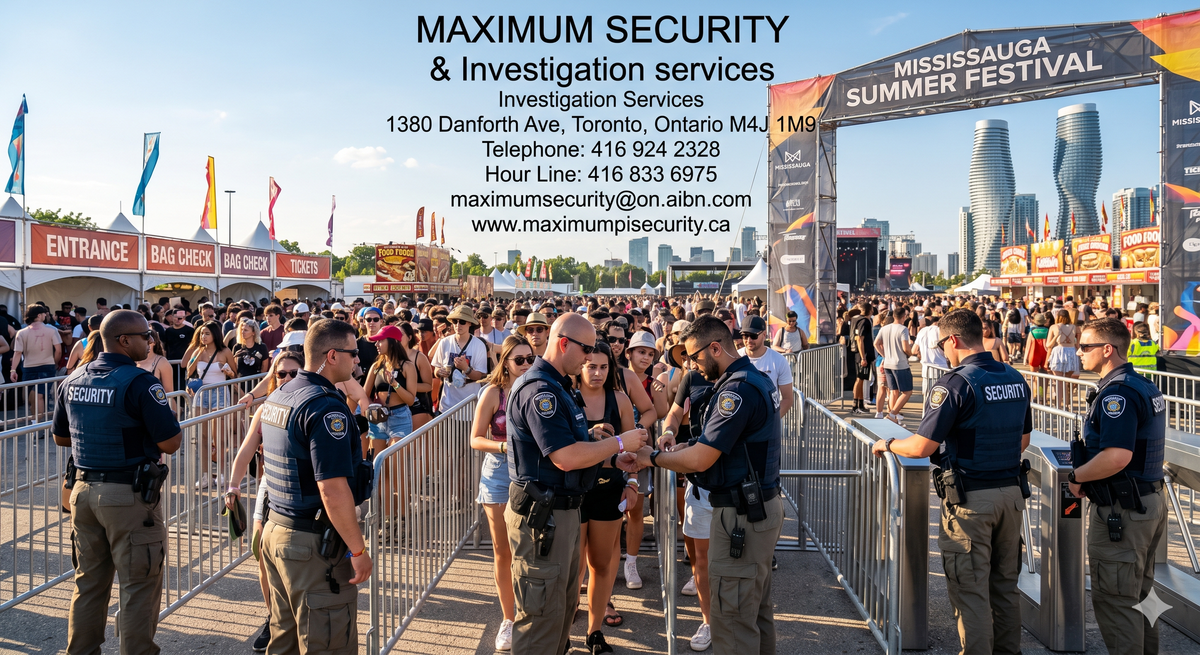
Summer and fall in Mississauga bring a massive surge of outdoor festivals, cultural celebrations, and food markets. When event organizers transform sprawling public spaces like Celebration Square, Port Credit Memorial Park, or the expansive grounds of the International Centre into high-density entertainment hubs, they instantly inherit profound logistical liabilities. Managing a localized crowd of thousands requires far more than setting up a few temporary fences and hiring ticket scanners. A disorganized perimeter, a failure to enforce municipal liquor laws, or an inability to manage severe crowd bottlenecks can result in catastrophic injuries, immediate event shutdown by Peel Regional Police, and the permanent loss of special occasion permits.
Event organizers and promoters are legally responsible for the physical safety of every attendee from the moment the perimeter opens. Relying on volunteer staff or untrained ushers to handle aggressive gate-crashers, monitor dense crowd dynamics, or execute a severe weather evacuation is an unacceptable risk. The Alcohol and Gaming Commission of Ontario (AGCO) and local Mississauga fire marshals enforce rigid compliance standards for temporary outdoor gatherings. Meeting these baseline mandates requires the deployment of professional, licensed security personnel trained specifically in aggressive crowd management. Understanding the foundational architecture of managing a large-scale event is critical; reviewing our comprehensive breakdown on How to Plan Special Event Security for GTA Venues provides organizers with the necessary blueprint for establishing safe, compliant operations across any municipality.
The localized operational reality in Mississauga is that outdoor venues often lack natural choke points. Securing a sprawling, open park next to Lake Ontario requires erecting a highly structured temporary perimeter and enforcing it with a physical security presence. Without a hard perimeter and professional gate staff, unauthorized individuals will inevitably breach the event, bringing prohibited items and severely compromising crowd capacity limits.
The Consensus Verdict on Crowd Bottlenecks
Field data consistently reveals that outdoor festivals utilizing narrow, single-lane entry gates without pre-screening zones experience a 50% higher rate of crowd crushing and gate breaches. Event organizers must deploy wide, multi-lane access points equipped with physical switchback stanchions and dedicated bag-check tables, and strictly avoid funnelling thousands of attendees into a single, highly compressed entry corridor.
Perimeter Hardening for Open-Air Mississauga Venues
The primary challenge of an outdoor festival in Mississauga is establishing a secure boundary in a naturally open environment. Standard chain-link fencing is easily compromised; determined individuals can lift it, cut the zip ties, or push it over in a coordinated surge. For high-capacity events, utilizing heavy-duty, interlocking steel barricades (Mojo barriers) around the primary footprint is mandatory.
A physical fence is only as effective as the guards monitoring it. Security personnel must be stationed along the interior perimeter to deter and intercept fence-jumpers. If a breach occurs, the roving guard must instantly extract the unauthorized individual before they vanish into the dense crowd. This aggressive perimeter enforcement mirrors the physical lockdown strategies utilized to protect sprawling urban sites, as detailed in our analysis of Pre-Construction Site Fencing and Asset Protection in Downtown Toronto, where establishing the property line is the first step in asset defense.
Estimated Mississauga Festival Security Tiers in CAD
| Security Function | Operational Deployment Focus | Estimated Hourly Bill Rate (CAD) | Primary Crowd Risk Target |
| Access Control & Bag Check | Ticket scanning, metal wanding, contraband denial | $25.00 - $30.00 | Weapons, outside alcohol, fake tickets |
| Tactical Crowd Management | Roving patrols, stage barricade support, de-escalation | $28.00 - $35.00 | Physical altercations, crowd crushing |
| AGCO Enforcement Specialist | Beer tent monitoring, ID verification, intoxication intercepts | $30.00 - $38.00 | Underage drinking, liquor license infractions |
Managing AGCO Liquor License Compliance
The most significant financial and legal vulnerability for any Mississauga festival is the service of alcohol. The AGCO operates with zero tolerance for infractions during special events. If an underage individual is found consuming alcohol, or if a highly intoxicated patron causes property damage after being over-served, the event organizer, the venue, and the security provider are all exposed to massive civil lawsuits and provincial fines.
Standard colored wristband systems are highly vulnerable to counterfeiting or transfer. Professional security deployments counter this by enforcing a secondary, highly mobile ID check protocol. Plainclothes or tactical guards must actively patrol the designated beer gardens, performing random age verifications on attendees consuming alcohol. Furthermore, security personnel must monitor the bar service lines to intercept noticeably intoxicated individuals before they reach the bartender. This proactive enforcement protects the event's liquor license and prevents alcohol-fueled violence from erupting in dense crowd pockets.
Advanced Crowd Dynamics, Evacuation Protocols, and Hostile Vehicle Mitigation
Securing a massive outdoor festival in Mississauga requires a deeply technical approach to threat mitigation. Moving beyond basic ticket scanning, professional security directors must analyze crowd psychology, implement engineered physical barriers, and prepare for rapid environmental shifts. This section explores the zero-competition operational strategies required to manage tens of thousands of attendees safely while neutralizing sophisticated external threats.
Analyzing and Controlling Crowd Density Swells
Crowd dynamics are highly fluid. An area that is perfectly safe at 2:00 PM can become a deadly crush zone by 8:00 PM when a headline act takes the main stage. The risk of compressive asphyxiation—where the sheer physical pressure of the crowd prevents individuals from expanding their lungs—is a critical threat at any dense outdoor music festival.
Licensed crowd management guards are trained to continuously monitor density levels. They do not passively watch the stage; they stand elevated on the stage barricade steps, facing the crowd, actively scanning for signs of distress. If a specific zone near the front rail becomes dangerously compressed, the security team must execute a "crowd split." This involves deploying a physical wedge of guards into the audience to break the forward momentum, forcing attendees to disperse laterally and relieve the structural pressure. Event organizers must also design their venue layouts to include wide, unobstructed lateral escape routes (vomitories) that allow individuals to easily exit the high-density pit areas without fighting against the incoming flow of traffic.
Executing Mass Evacuations During Severe Summer Weather
Mississauga's proximity to Lake Ontario makes it highly susceptible to rapid, severe summer thunderstorms and microbursts. A clear afternoon can violently shift into a lightning storm with high-velocity winds capable of toppling temporary scaffolding, speaker towers, and vendor tents. When Peel Regional Police or the local fire marshal orders an immediate evacuation, the security team has mere minutes to clear thousands of people from the danger zone.
During a mass evacuation, a crowd's psychology instantly shifts from compliant to panicked. Security guards must instantly transition from access control to evacuation directors. The primary directive is to immediately open all emergency egress gates—including cutting the zip-ties on perimeter fencing if necessary—to relieve pressure from the main entrance bottlenecks. Guards must utilize high-intensity megaphones and assertive physical direction to funnel the crowd away from structural hazards and toward designated municipal safe zones or hard-structure transit shelters. This requires extensive pre-event briefings, ensuring every single guard knows the exact egress route for their specific sector.
Deploying Hostile Vehicle Mitigation (HVM) Assets
In the modern landscape of event management, the threat of a hostile vehicle intentionally or accidentally breaching a dense pedestrian crowd is a severe concern. Festivals involving temporary street closures, such as cultural parades through Port Credit, or events utilizing open parking lots, are highly vulnerable to vehicular incursions.
Standard orange traffic cones, wooden sawhorses, or caution tape provide absolutely zero physical stopping power. Professional outdoor event security requires the deployment of engineered Hostile Vehicle Mitigation (HVM) assets. This includes positioning heavy municipal sanitation trucks, water-filled jersey barriers, or engineered mobile crash barriers across every active roadway intersecting the pedestrian footprint. Security guards stationed at these barricades control the limited access for authorized emergency vehicles, ensuring the pedestrian zone remains completely isolated from unauthorized vehicular traffic. This aggressive hardening mirrors the physical access control logic required for managing sprawling industrial sites, an operational standard detailed in Mobile Security Patrol Services for Industrial Parks in Mississauga.
Medical Emergency Extraction Corridors
When a medical emergency occurs deep within a crowd of ten thousand people—such as a cardiac event or severe heat exhaustion—paramedics cannot physically push a stretcher through the density. If the response is delayed, the outcome is often fatal.
Security directors must engineer dedicated medical extraction corridors into the venue layout before the first fence panel is erected. These are physically barricaded, sterile lanes that run from the deepest parts of the crowd directly to the medical staging tents or ambulance bays. When an incident occurs, the crowd management guards locate the victim, secure a perimeter around them, and rapidly extract them via the sterile corridor, ensuring paramedics have immediate, unimpeded access to the patient.
Managing High-Volume Traffic and Parking Gridlock
The logistical challenge of an outdoor festival begins on the municipal roads leading to the venue. The sudden influx of thousands of vehicles creates severe traffic gridlock and chaos within the designated parking areas. Attendees, desperate to reach the gate, will park illegally in fire lanes, block pedestrian walkways, and obstruct emergency vehicle access routes.
To maintain order, the security deployment must include certified private property parking enforcement guards. These guards manage the flow of traffic, direct vehicles into structured rows to maximize lot capacity, and instantly coordinate with local towing vendors to remove any vehicle compromising a designated fire route. This organized approach prevents the exterior of the festival from devolving into a dangerous free-for-all, utilizing the exact strict enforcement mechanics we outlined in Condo Parking Enforcement Security Guards in Mississauga: Guide.
Intercepting Advanced Counterfeit Ticketing Rings
With the dominance of digital ticketing, organized fraud rings sell highly realistic counterfeit QR codes to desperate fans just outside the venue gates. When dozens of fans arrive at the turnstiles with fake tickets, it creates an immediate, highly volatile bottleneck. Angry attendees frequently argue with the gate staff, attempting to force their way through the perimeter.
To neutralize this threat, security planners must push the verification perimeter outward. Professional teams utilize a "soft check" outer perimeter. Guards positioned fifty meters away from the main gate visually inspect tickets and route attendees into specific queueing lanes. If a ticket scans as invalid at the main terminal, the individual is immediately pulled out of the line and escorted to a designated "Customer Resolution" tent located away from the flow of traffic. This prevents the dispute from blocking the primary gate and ensures the continuous, safe flow of legitimate ticket holders into the venue.
If your organization is planning a major outdoor festival, food market, or high-capacity cultural event in Mississauga, request a custom security quote from Maximum PI Security to deploy a highly trained crowd management force and ensure your perimeter is fully compliant today.

Frequently Asked Questions
Can festival security guards legally confiscate outside alcohol at the gate?
Yes. Entering a ticketed or private outdoor event is a conditional agreement. The event organizer establishes the rules of entry, which explicitly forbid outside alcohol to maintain AGCO compliance. If a bag search reveals contraband, the licensed security guard has the legal authority to confiscate the items as a condition of entry, or the attendee can refuse the search and be legally denied access to the property under the Trespass to Property Act.
How do security guards handle a fight that breaks out in the middle of a dense crowd?
When a physical altercation erupts in a dense crowd, the security team immediately executes a coordinated tactical response. A wedge of guards pushes through the crowd to reach the incident. Their primary directive is to instantly separate the combatants, de-escalate the violence using physical presence and verbal commands, and rapidly extract the individuals from the dense area via the safest egress route. The individuals are then formally ejected from the venue and handed over to Peel Regional Police if assault charges are warranted.
Do we need to hire Paid Duty Officers from Peel Regional Police for our festival?
The requirement to hire Paid Duty Officers depends heavily on the scale of your event, the capacity, and the parameters of your AGCO permit. While private security guards manage internal crowd dynamics, ticket screening, and liquor compliance, the municipality often mandates Paid Duty Officers to manage external municipal road closures, direct heavy arterial traffic, or provide an armed deterrent for events with a history of extreme high density.
A licensed event security guard ensures the safety of outdoor festivals in Mississauga by executing strict perimeter bag checks to intercept contraband, continuously monitoring crowd density to prevent crush zones, and aggressively enforcing AGCO liquor laws to prevent alcohol-related violence. Operating under the Ontario Trespass to Property Act, these professional teams provide the physical enforcement required to execute safe mass evacuations and neutralize unauthorized gate-crashers before they compromise the event footprint.
About the Author
Jeff Calixte is an online exclusive content sell strategist with a deep background in tracking local asset protection data, analyzing Southern Ontario labor rates, and outlining real operational deployment structures across the Greater Toronto Area.
Sources
- Alcohol and Gaming Commission of Ontario (AGCO) - Special Occasion Permits
- Peel Regional Police - Special Event and Paid Duty Guidelines
Note
Commercial bill rates, guard wages, deployment conditions, and vendor availability can vary widely by province, municipality, season, and project scope. All pricing estimates, labor figures, and career examples in this guide are approximations based on current Ontario market data. Always confirm contract details, licensing compliance, and specific rate quotes directly with your chosen service provider or employer before finalizing any agreements.